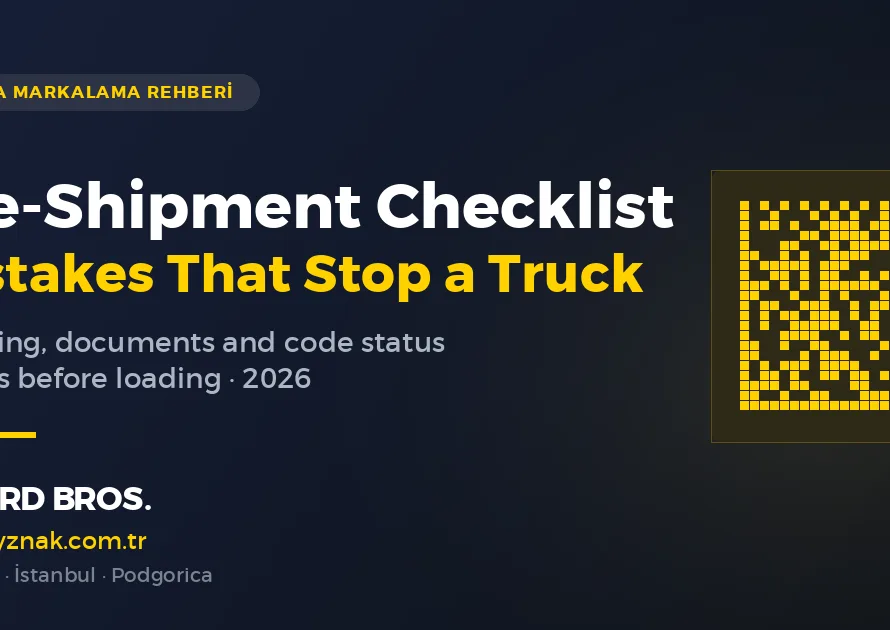
Chestny Znak (Честный ЗНАК) is Russia’s mandatory digital product marking and traceability system, required for a growing list of product categories. Each item receives a unique DataMatrix code that records its journey from production to final sale in the state database (GIS MT). A product without a code cannot be legally sold in Russia.
Translating roughly as “honest mark”, the system is no longer a technical detail for Turkish companies exporting to Russia — it is a precondition for clearing customs. Below we explain, in plain language, what the system is, how it works and what exporters need to do.
What is Chestny Znak for?
The system’s purpose is to remove counterfeit, smuggled and unregistered goods from the market and to make the supply chain fully transparent. Because every item is tracked by its unique code, each change of ownership between manufacturer, importer, wholesaler and retailer is reported to the system. Even a consumer can scan a product’s code with a phone to confirm it is genuine. For the Russian state, this is a central traceability layer that reduces tax loss, protects consumers and lets the market be monitored.
How does the system work?
Its logic rests on three pillars:
- Unique code: a DataMatrix code is generated for each product — a GS1-based, encrypted square that uniquely identifies the item.
- Central registry (CRPT / GIS MT): codes are held in the national database managed by the system operator, CRPT.
- Movement reporting: as a product moves from production to the shelf, each step (import, transfer, sale) is reported via electronic document flow.
So Chestny Znak is not merely “sticking on a label”; it is a process of generating the code, applying it to the product and reporting every movement to the system.
Which products are in scope?
Scope expands not all at once but product group by product group, on a staged timeline. Starting with tobacco, footwear and medicines, the obligation spread to textiles and apparel, dairy, perfumery, chocolate, beverages, cosmetics and many more. Whether your product is in scope is defined by its customs tariff position (TN VED in Russia). Our guide to products covered by Chestny Znak and their customs codes is a good starting point; for a definitive answer, we confirm your product group together.
“Square code”, QR code, DataMatrix — which is it?
The Chestny Znak code is often called a “Russia QR code”, but it is a DataMatrix code, not a QR code — both are square, yet they are different standards. We explain the distinction and how the term relates to Chestny Znak in What Is the Russia QR/Square Code?
What does it mean for Turkish exporters?
In practice the rule is clear: you cannot bring an in-scope product into Russia without marking it with a Chestny Znak code. If the code is missing, the goods are held at customs, the buyer cannot accept them into their warehouse, and they never reach the shelf. That is why marking must be addressed at the start of your shipment plan — not at the last minute. Marked products enter Russia legally.
How do you comply with Chestny Znak? (step by step)
The typical sequence for an exporter is:
- CRPT registration: register your company with CRPT, the Chestny Znak operator.
- Electronic signature (UKEP): a qualified electronic signature is required to sign operations on the Russian side — see our UKEP guide.
- GTIN and product card: obtain a GS1 barcode/GTIN for each product and open a product card in the National Catalogue.
- Code generation and application: generate and print a DataMatrix code on each individual item.
- Reporting via EDO: report each change of ownership through electronic document flow (EDO).
Our end-to-end Russia labelling guide pulls this whole process together and gives the common framework for all categories.
Verify the code before shipping
The most expensive mistake that stops a load at the border is a code caught too late. Selecting samples from your goods and confirming that the codes are valid and readable in the system before shipment is the cheapest insurance. With our free code lookup tool you can check a code’s status in seconds.
Frequently asked questions
Is Chestny Znak mandatory?
For in-scope product groups, yes — without a code, sale and customs clearance in Russia are not possible. Scope depends on the product group and date.
Who applies the code, us or Russia?
Codes can be applied from production onward; labelling in Turkey or in Russia is both possible. Pre-customs labelling reduces risk at the border.
Is the Chestny Znak code a QR code?
No, it is a DataMatrix code. Both are square, but they are different standards.
How long does the process take?
It varies with CRPT registration, UKEP and product-card preparation; let’s plan it together based on your product group.
How do I know if my product is in scope?
Your customs tariff position (HS/TN VED) is decisive. Send us your code and we’ll confirm it together.
We manage the Chestny Znak process end to end
Chestny Znak is a technical process of registration, coding and reporting — smooth when set up correctly, a load stuck at the border when neglected. As Global Znak Consulting, with offices in Moscow and Istanbul, we manage the entire process from CRPT registration to code application and EDO reporting. The first consultation is free. For your product group, get in touch with us, review our service packages on the solutions page, and browse other guides on our blog.
Disclaimer: This article is for general information and relies on public sources. Marking scope and effective dates may change; confirm your specific obligation according to your product group.